


What is the Relative Strength Index?
The Relative Strength Index (RSI) is one of the most widely used momentum indicators in trading. Developed by J. Welles Wilder, it measures the speed and magnitude of recent price changes to determine whether an asset is overbought or oversold. RSI values range from 0 to 100, with readings above 70 traditionally signaling overbought conditions and readings below 30 suggesting oversold conditions.
Because it blends price momentum and relative performance, RSI helps traders spot potential turning points, confirm trends, and gauge the strength of market moves.
Key Principles of RSI
The RSI is calculated by comparing the average gains to the average losses over a set period, typically 14 days. The formula generates a value that fluctuates between 0 and 100, making it easy to visualize momentum shifts.
- Above 70: The asset may be overbought, and a pullback or correction could follow.
- Below 30: The asset may be oversold, and a bounce or reversal could occur.
- Between 30–70: Normal trading conditions, where RSI can be used to assess trend strength rather than reversals. 50 is the average with below 50 being perceived as bearish momentum and above 50 being perceived as bullish momentum.
How Traders Use RSI in Decision Making
1. Identifying Overbought and Oversold Conditions
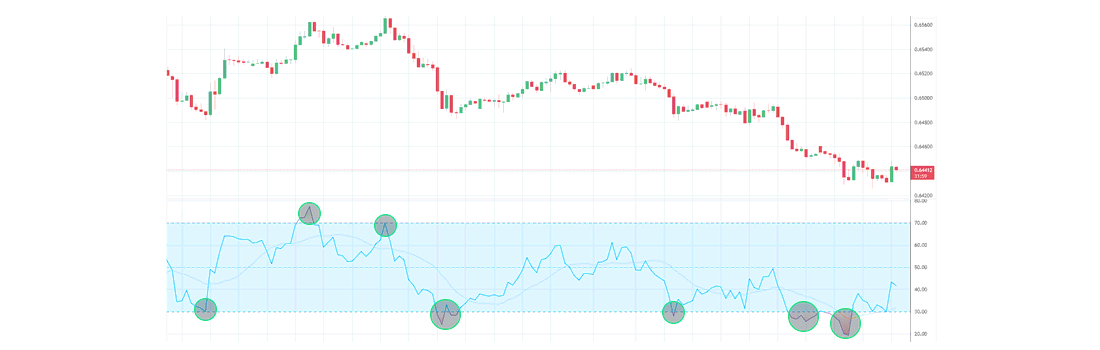
One of the most common uses of RSI is spotting when prices may have moved too far, too fast. For example, if a stock climbs rapidly and RSI crosses 70, traders may prepare for a short-term pullback. On the other hand, if RSI dips below 30, traders may look for buying opportunities as selling pressure eases.
2. Spotting Divergences
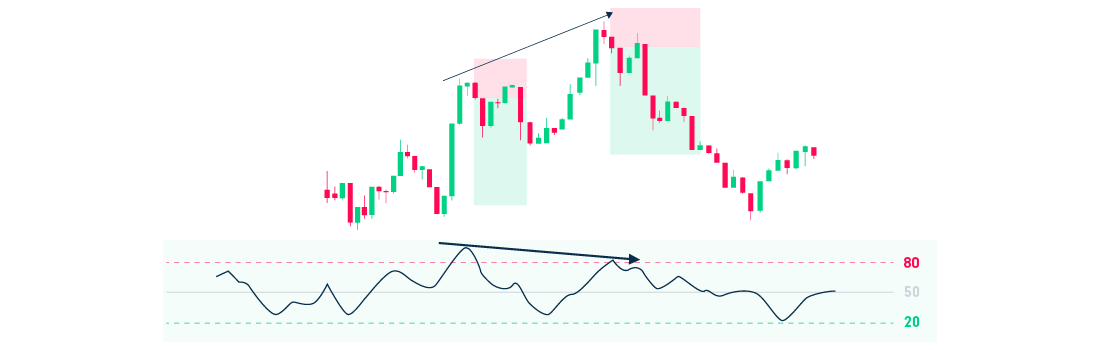
A divergence occurs when price moves in one direction, but RSI moves in another. For instance:
- Bullish divergence: The price makes a new low, but RSI forms a higher low, signaling weakening downward momentum and a possible reversal upward.
- Bearish divergence: The price makes a new high, but RSI forms a lower high, suggesting fading strength and potential downside risk.
Divergences are powerful warning signals that trends may be about to change.
3. Confirming Trends
RSI is also useful in trend-following strategies. During strong uptrends, RSI often stays above 40–50 and frequently pushes into the 70–80 range. In strong downtrends, it tends to remain below 50 and may frequently hit 20–30. Traders use these thresholds to confirm that momentum supports the ongoing trend, avoiding premature entries against the prevailing market direction.
4. Timing Entries and Exits
By combining RSI with support and resistance levels or candlestick patterns, traders refine their entry and exit timing. For instance, a trader might wait for RSI to exit the overbought zone and fall below 70 before selling, or for it to rise back above 30 before buying.
Strengths and Limitations
The RSI is simple, intuitive, and effective in many market conditions. It helps traders identify exhaustion points, avoid chasing trends, and gain confidence in timing trades. However, RSI is not foolproof. In strong trending markets, assets can remain overbought or oversold for extended periods, leading to false signals if used in isolation.
Additionally, the RSI will not always indicate every reversal about to happen. It will signal an eventual reversal but reversals can happen consistently without being perceived overbought or oversold and when it is overbought or oversold on one time chart that does not mean it is on all charts so one should take that in consideration when predicting how long of a reversal could be expected.
Also, it is good to monitor that each asset may have different patterns of when reversals happen at different levels of the RSI on different time frames.
Final thoughts
The Relative Strength Index is a versatile tool that enhances trading decisions by highlighting momentum shifts, divergences, and potential reversals. When combined with other forms of analysis—such as chart patterns, volume, and fundamentals—RSI becomes a reliable ally for traders seeking to navigate markets with greater precision.